AI-Generated Resumes Broke the Screen: What Replaces It
Resume screening has long rested on one assumption: a well-written resume hints at a capable candidate. AI-generated resumes have weakened it. Applications per job on Greenhouse rose from 116 in 2022 to 244 in 2025, according to its Hire Standard benchmark of 6,000+ companies, though the report doesn’t isolate AI’s share. In my view, volume isn’t the hardest part. Strong and weak applications now look more alike.
Here’s why, and how structured first interviews turn resume claims back into evidence.
Why Did AI-generated Resumes Weaken Resume Screening?
Because AI made polish cheap, and cheap polish separates candidates less.
AI-generated resumes are documents drafted or revised with Generative AI. They can describe genuine experience accurately, but their wording can’t prove the candidate did the work.
In 1973, economist Michael Spence showed that a signal helps employers distinguish candidates when it is costlier for weaker candidates to acquire. Applying that to resumes is my interpretation, not his: a tailored, well-written document once carried some of that cost, because it took time, skill and good advice. Generative AI has lowered it sharply. In a Q4 2024 Gartner survey of 3,290 candidates, 39% said they used AI during the application process, most often to generate resume text. The experience, qualifications and history a resume lists still matter. The presentation around them says less.
Why Doesn’t Filtering Harder Fix It?
Tighter keyword matching grades the same document AI helps tailor, so it rewards tailoring more than capability. Greenhouse CEO Daniel Chait calls the result a “doom loop”: candidates use AI to apply wider, employers use AI to filter harder, and rejected candidates apply wider still.
Detection is a shaky fallback. OpenAI withdrew its own AI-text classifier in 2023, citing low accuracy, and drafting with AI isn’t dishonesty in itself. A false flag costs you a real candidate.
None of this makes the resume useless. Read closely, it is a good map of where to probe. The mistake is treating it as the verdict rather than the starting point for the conversation.
What Still Carries Hiring Signal?
Evidence that is harder to fake. Sackett and colleagues’ 2022 analysis in the Journal of Applied Psychology ranked structured interviews highest among the selection methods examined, with a mean validity of .42 for predicting job performance, ahead of cognitive ability tests at .31. That’s a correlation, not 42% accuracy, and results vary by setting. (I’ve unpacked what that data means for interview design separately.)
A candidate can rehearse an answer to a predictable question. Rehearsing the third follow-up to an answer they just gave is much harder. Live interviews aren’t immune to AI assistance, but well-probed structure makes faking costlier, especially when the interviewer can see in the moment which claims were verified and which still need a follow-up.
How Do You Turn a Resume Claim Into Evidence?
Take an illustrative claim: “Reduced customer onboarding time by 30%.” I’d build the first conversation around four checks:
- Baseline. What did onboarding time measure, over what period, for which customers?
- Ownership. What did the candidate change personally, versus the team?
- Judgment. Which option did they reject, and why?
- Transfer. If volume doubled without extra staff, what would they change first, and why?
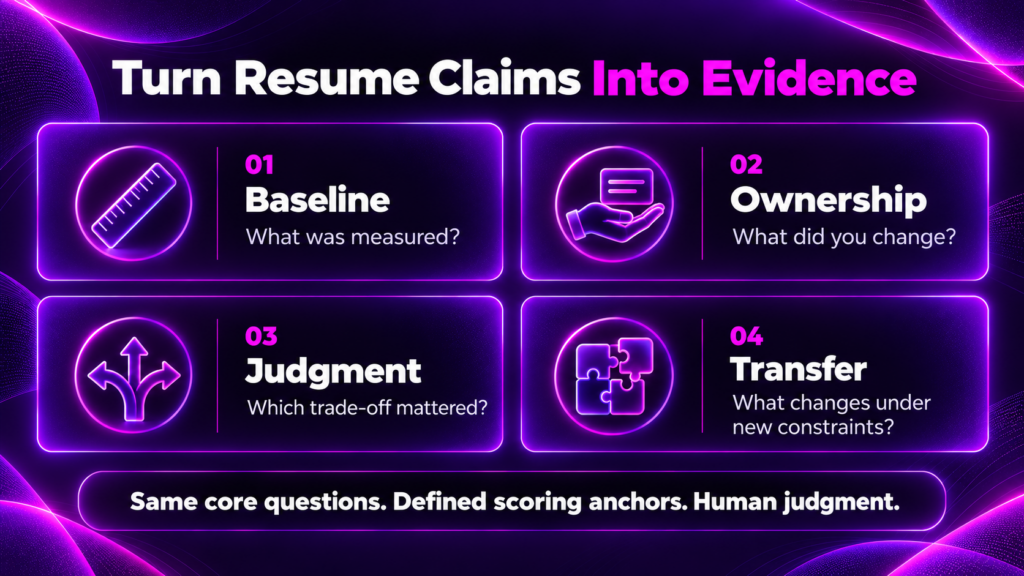
Define strong answers before interviewing: clear measurement, specific ownership, reasoned trade-offs, a credible response to the new constraint. Keep core questions and scoring anchors identical. Tailor only the follow-ups. A detailed story is still the candidate’s account, so add a work sample where real doubt remains.
What Should the Next Interviewer Receive?
Start with a Blueprint the recruiter builds from the role and the hiring manager approves: priority competencies and the evidence each requires. The recruiter leads the conversation while AI surfaces real-time insights, suggests follow-ups and organizes the evidence; a person owns the decision.
The Interview Report should tie each rating to a response, explain the rationale and flag unresolved questions, so Next Round Prep builds on the evidence instead of repeating round one, and points the next interviewer to the single question that would settle the decision.
To test it, I’d track how often hiring managers re-ask first-round questions because the evidence was missing or unusable, comparing similar roles before and after.
The Resume Isn’t Dead. It’s Been Demoted.
AI-generated resumes didn’t create a hiring problem; they exposed one. We leaned on how well candidates described their work, which was more reliable when describing it well was hard. The answer isn’t catching AI. It’s making the first conversation informative enough that polish matters less. That’s the thinking behind Relevana: Stop Screening, Start Interviewing. Start with one role in a 60-day free pilot and see whether the next decision gets clearer.
