What AI Interview Software Actually Changes, According to Hilton’s Numbers
Hilton’s experience suggests that AI interview software can affect three areas: hiring speed, recruiter capacity, and post-hire outcomes. Those results should not be treated as interchangeable.
Moving faster shows that a workflow became more efficient. Lower turnover may indicate stronger selection. Understanding that distinction is more useful than repeating one dramatic percentage.
What Hilton’s Results Reveal
Hilton-reported figures published by HireVue state that the company shortened time to hire from six weeks to six business days, increased recruiter productivity tenfold, and lowered turnover by nearly 30% after expanding digital interviewing across more than 90 countries.
These are reported outcomes, not independently controlled findings. Still, each number represents a different operational change:
- Six weeks to six business days measures flow. On-demand interviews reduced calendar dependency, allowing candidates to complete early-stage assessments without waiting for a recruiter.
- 10-fold productivity measures capacity. Recruiters could process more candidates because technology reduced repetitive screening and coordination work.
- Nearly 30% lower turnover measures post-hire outcomes. This is the most consequential result, but also the one requiring the most caution. Hilton reported the decline alongside its technology rollout. That correlation does not establish that interview software alone caused it.
Notably, Hilton’s speed gains came from removing the recruiter from early interviews. That trade-off may suit high-volume roles, but it raises a harder question for professional hiring: what signal is lost when no one is in the conversation to probe deeper?
The takeaway is not that every employer should expect Hilton’s percentages. It is that hiring technology must be evaluated beyond the point of offer.
What Chipotle’s Results Reveal About Throughput
Chipotle provides a useful contrast.
After introducing conversational AI for frontline hiring, the company reported reducing application-to-start time from 12 days to four. Application completion increased from approximately 50% to more than 85%, while applicant flow nearly doubled, according to its February 2025 company update.
Those results demonstrate reduced friction and greater throughput. They do not, by themselves, demonstrate better hiring decisions.
Rapid throughput may be the right priority for high-volume frontline hiring. Professional hiring teams seeking stronger selection evidence cannot evaluate AI interview software using scheduling and completion metrics alone.
Build the Measurement Plan Before the Pilot
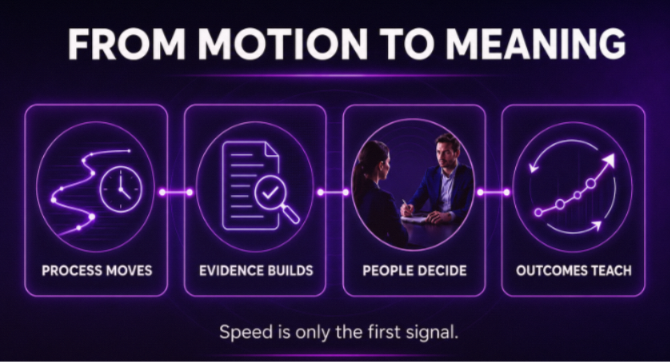
A credible pilot should track four layers:
- Flow: Time between application, interview, feedback, and decision.
- Capacity: Recruiter and interviewer hours required per hire.
- Decision quality: Scorecard completion, evidence coverage, and alignment against pre-approved criteria.
- Post-hire outcomes: Early turnover, ramp time, manager satisfaction, and job performance.
Decision quality is where many implementations fail. Organizations frequently install technology before agreeing on what a strong candidate must demonstrate. Without pre-agreed criteria, automation merely accelerates inconsistent judgment.
Even structured interviews lose value when their evidence does not reach the next decision-maker. Relevana’s analysis of how to hand off interview evidence that actually gets used explains why decision quality depends on evidence traveling forward rather than remaining trapped in recruiter notes.
What Relevana Changes
Relevana applies that principle through a deliberately human-led, AI-assisted process.
A faster process is useful only if each conversation gives the next decision-maker something credible to work with. Relevana starts with an agreed interview Blueprint, supports a live conversation led by the recruiter, and carries the resulting evidence into an Interview Report and Next Round Prep. That gives hiring teams a way to measure more than elapsed time: what the first interview established, what remains uncertain, and whether the next round moves the decision forward.
For a deeper examination of how hiring teams can improve speed without sacrificing signal, trust, or human connection, read Relevana’s white paper, Human-Led Hiring in the AI Era.
