Candidate Experience: Where AI Hiring Loses People
AI can remove friction from hiring. Where it loses candidates is when it replaces the conversation.
A candidate starts an application but cannot get a simple question answered. Another finishes an interview and waits ten days for an update. Neither delay helps your team assess anyone. Both give the candidate a reason to leave.
That is why I see candidate experience as an operating measure as much as a branding one. Track where people stop applying, where they wait, and what happens after an offer. Then fix the friction without cutting the conversations that help people make a sound decision.
Chipotle’s Application Completion Lesson
After introducing its conversational AI assistant, Chipotle reported that application completion rose from approximately 50% to over 85%. Average time from application to starting work fell from 12 days to four. At those completion rates, 100 application starts would produce at least 35 more completed applications.
The assistant answered questions, collected basic information, scheduled interviews, and sent offers after managers selected candidates. It reduced administrative work around the hiring decision. These are Chipotle-reported results from high-volume restaurant hiring, and they do not isolate the assistant’s effect.
The useful question for any team is narrower. How many interested candidates leave before we have learned enough about them?
Candidates Care Where AI Has Authority
Volume makes that question harder to ignore. Greenhouse’s 2026 recruiting benchmarks show an average of 244 applications per job on its platform in 2025, while annual applications per recruiter rose 412% from 2022.
Automation can help teams respond at that scale. Its role in assessment needs more care. In Pew Research Center’s 2023 survey, 71% of U.S. adults opposed AI making a final hiring decision, and 66% said they would not want to apply to an employer using AI to help make hiring decisions. Yet 47% thought AI could do better than people at treating every applicant the same way. Gartner separately found that only 26% of surveyed candidates trusted AI to evaluate them fairly. Greenhouse’s 2026 research adds a sharper signal: 38% of candidates have walked away from a hiring process because it included a bot-led interview.
Read together, these numbers point less to rejecting AI than to distrusting AI that candidates cannot see, question or appeal to. The consistency people credit AI with is worth keeping. The authority belongs with a person.
I would explain three things to candidates: what AI helps organize, who speaks with them, and who makes the decision. Disclosure cannot repair a process that feels unaccountable. It can make a well-designed process understandable.
Run a Candidate Experience Audit
Start with one role family and compare equivalent hiring cohorts. Measure four points:
- Application completion: Of candidates who start, how many submit?
- Time between stages: How long do candidates wait for a response, an interview, and a decision?
- Repeated assessment: How often does a later interviewer ask about something already established?
- Offer acceptance: Of offers made, how many are accepted, and what reasons do candidates give when they decline?
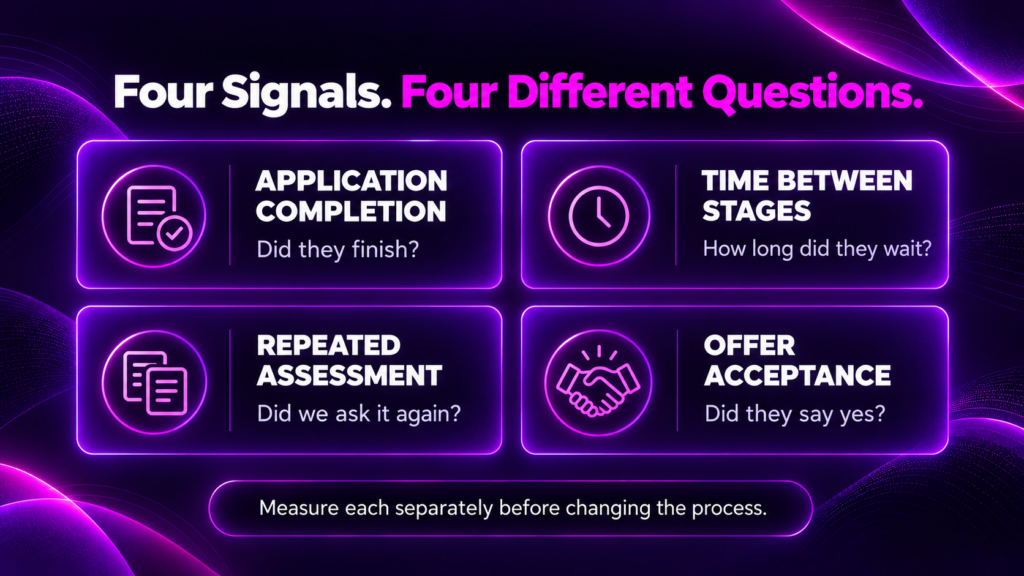
Do not blend these into one score. A shorter application may improve completion without changing offer acceptance. A faster interview schedule may still leave candidates repeating themselves. Review each measure after a process change and ask candidates what happened before assigning a cause.
That third measure is especially important in professional hiring. When interview evidence fails to travel, the next interviewer starts over, and the candidate experiences another round without visible progress. Better structured interviews can preserve depth while reducing that repetition.
The interview is also where candidates form their view of the employer. A candidate who feels heard in round one is more likely to stay engaged through round three and to accept at the end.
Keep the Conversation Human
Relevana starts with a Blueprint the recruiter builds from the role and the hiring manager approves before the first interview. A recruiter leads the live conversation while AI works in the background, surfacing real-time insights and suggested follow-ups so the recruiter can go deeper without losing rapport.
For candidates, that should mean a conversation that builds on what they have already shared. For hiring teams, it creates a record they can use without asking someone to tell the same story again. See how Relevana keeps every interview human-led and connects the first conversation to the next decision.
