How Better First Interviews Could Return $1,320 Per Hire

I have noticed that most hiring teams track calendar invites, not the labor hours behind them. That distinction can conceal more than $1,000 in technical-team capacity per hire. When an interview does not create enough confidence, teams add another round that often repeats qualification work which should have happened earlier.
The hidden cost is not the conversation itself. It is a conversation that produces too little structured, transferable evidence for the next interviewer.
- Picture this: Aline Lerner’s interviewing.io model estimates approximately 55 cumulative person-hours per engineering hire: 15 hours of recruiting labor and 40 hours of engineering interview labor. To make that hidden capacity visible, I modeled a 33% reduction in the 40-hour engineering labor pool. That returns 13.2 hours, equivalent to a 24% reduction against the full 55-hour baseline.
At an illustrative blended rate of $100 per hour, the modeled capacity value is $1,320 per hire.
I want to be clear about what these numbers represent: transparent assumptions to test against each organization’s workflow, not guaranteed results.
Interview Cost per Hire Should Count People, Not Meetings
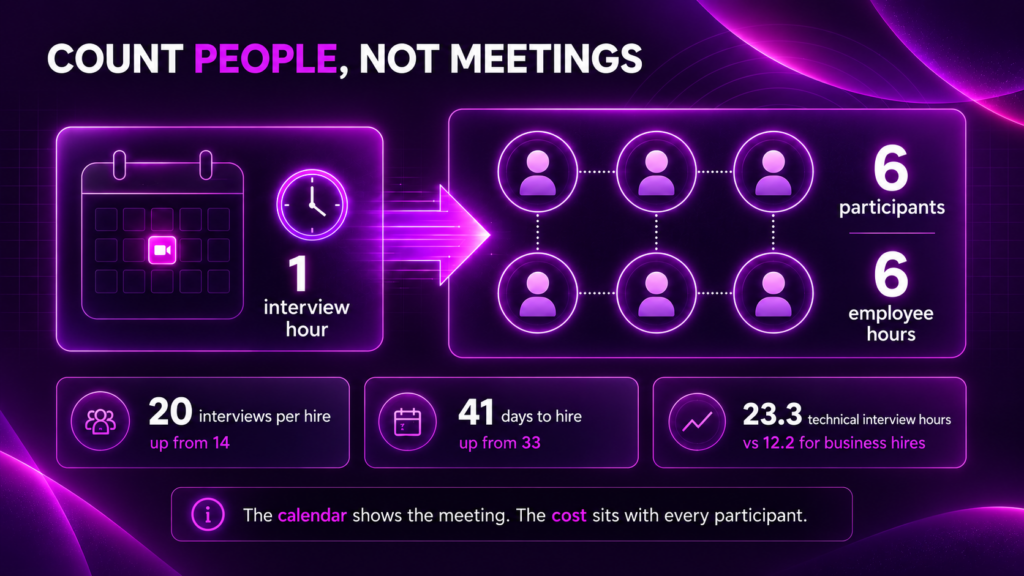
Gem’s 2025 Recruiting Benchmarks Report found that hiring teams conducted 20 interviews per hire in 2024, compared with 14 in 2021, a 42% increase. Time to hire rose from 33 to 41 days.
Ashby’s 2026 Talent Trends Report puts recorded interview time at 23.3 hours per technical hire, compared with 12.2 hours per business hire.
Interview-event counts can still miss participant labor. A one-hour panel with six employees is one interview event and one candidate hour, but six employee hours. A useful interview cost per hire calculation must count every participant’s time.
Where Interview Labor Becomes Rework
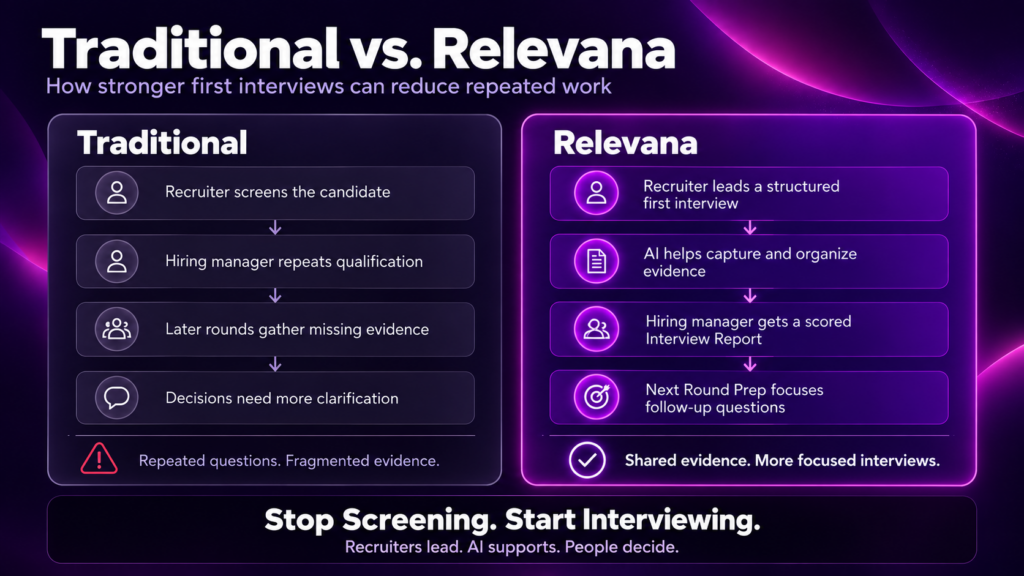
When interview evidence does not transfer between rounds, each conversation produces an independent set of notes and impressions. The next interviewer begins without a reliable view of what has already been established.
Hiring managers repeat foundational qualification. Specialists meet marginal candidates. Panels reassess resolved competencies. Teams add unnecessary interview rounds because earlier conversations did not create conviction.
Every interview consumes time, but the evidence does not compound.
A Transparent $1,320 Model
The model leaves the 15 recruiting hours unchanged and treats the 40 engineering hours as the addressable pool. For the expected case, we assume that stronger first-interview evidence returns 33% of that engineering labor:
- 40 hours × 33% = 13.2 hours returned
- 13.2 ÷ 55 = 24% of total interview labor (based on Lerner’s 55-hour baseline)
At an illustrative blended, fully loaded labor rate of $100 per hour:
13.2 hours × $100 = $1,320 in labor capacity returned per hire
The scenario range makes the assumption explicit:
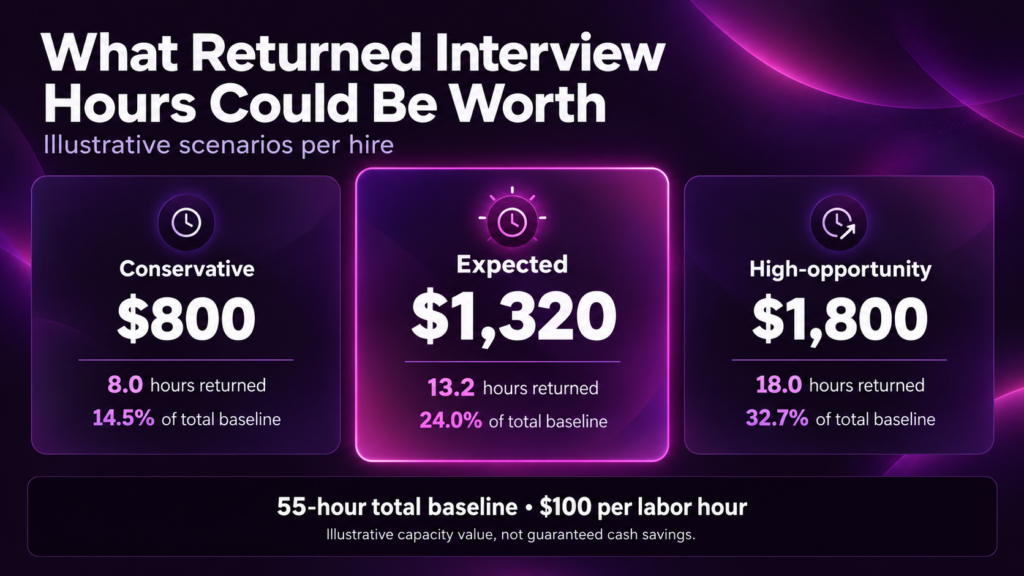
I use 33% as an illustrative expected-case assumption based on early customer experience data, although it requires further validation across a larger customer base. Applied to the 40-hour engineering labor pool, it returns 13.2 hours, or 24% of the full 55-hour baseline. Neither figure is an industry benchmark or guarantee. Organizations should replace the assumption with their measured rate of repeated or avoidable engineering interview labor.
What Must Change for the Model to Hold?
Three conditions must exist.
Talent Acquisition and the hiring manager first align on role-specific competencies, weights, and evaluation criteria. A recruiter then leads a live, people-led interview while AI assists with question depth, scoring, and documentation. The technology strengthens the interviewer; it does not replace the conversation with an autonomous bot.
Finally, the evidence must travel. The next interviewer needs to know what the candidate demonstrated, what remains unresolved, and where to focus. Relevana supports these functions through its Blueprint, Interview Report, and Next Round Prep.
This is where I believe the modeled hours could come from: fewer marginal candidates progressing, less repeated qualification, more targeted specialist interviews, and fewer rounds added to resolve incomplete evidence.
The U.S. Office of Personnel Management reports that interviews with greater structure show higher validity, reliability, and rater agreement. That evidence supports the proposed mechanism, but it does not validate the modeled 33% engineering-hour reduction or the resulting 24% total reduction.
Capacity Is Not Automatically Cash
Across 100 technical hires, the expected scenario represents $132,000 in annual labor capacity at a $100 loaded rate. It becomes cash savings only when it reduces overtime, contractor spending, or additional headcount needs. Otherwise, it is capacity returned to productive work.
The calculation excludes vacancy cost, candidate experience, decision speed, recruiter documentation time, and avoided poor-hire costs. Excluding them prevents double counting.
Every interview should reduce uncertainty, not pass it forward. Relevana creates structured evidence from the first conversation. Book a demo to benchmark your participant-hours on a live role.
