From Recruiter to Hiring Manager: How to Hand Off Interview Evidence That Actually Gets Used
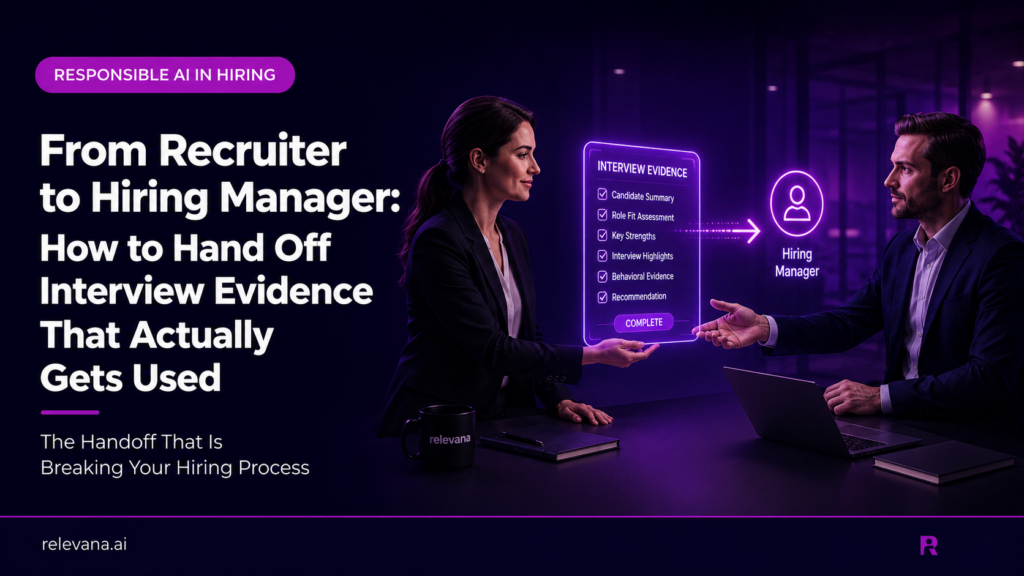
The Handoff That Is Breaking Your Hiring Process
A recruiter spends forty-five minutes with a candidate. They walk away with a clear picture: how the candidate handled a difficult situation, where they struggled, what one question opened up something genuinely interesting. Three hours later, the hiring manager gets a message: “Strong candidate. Worth a call.”
That is not a handoff. It is a summary of a summary. LinkedIn’s 2025 Future of Recruiting report found 89% of talent acquisition professionals say measuring quality of hire is increasingly important, but only 25% feel confident their organization can do it. The handoff is where that confidence gap begins.
Why Memory Is Not a Handoff Strategy
Memory-dependent debriefs are structurally unreliable. A 2022 study in Psychiatry, Psychology and Law found immediate, structured documentation produced more accurate records than delayed recall. Accuracy dropped as time between event and debrief increased. By the time recruiters hand off a forty-five-minute interview, they’ve already filtered out critical details.
The specifics disappear first: the example that raised a concern, the hesitation before a particular answer, and the question that uncovered something worth exploring. What survives is the impression. Concerns travel only as far as the recruiter’s comfort with sharing them.
SHRM’s 2025 Benchmarking Survey found the average cost-per-hire is $4,700, and replacing a bad hire costs between 50% and 200% of annual salary. SHRM also found 56% of hiring failures stem from inadequate skills assessment. A handoff built on impressions is a financial risk, not a process inconvenience.
What Candidates Experience When Handoffs Break Down
For candidates, a broken handoff has one symptom: repetition. Every handoff resets the interview. A new interviewer walks in without context, asks the same questions, covers the same ground, and repeats work the team has already done.
According to GoodTime’s 2025 Hiring Insights Report, 45% of talent acquisition leaders say they now require more hiring touchpoints than in previous years, not because candidates need more evaluation, but because interview evidence from earlier rounds doesn’t carry forward. Each new interviewer starts from zero and adds time without adding a signal.
Top candidates do not absorb this patiently. Gem’s 2023 research found the best candidates are off the market within 10 days. A handoff problem that forces one additional round is a pipeline risk because the candidate who accepts another offer does not explain why.
- Pro tip: If your candidates are asking “didn’t I already cover this?” in round two, that’s not a candidate experience problem to smooth over. It’s a signal that your evidence isn’t traveling. Fix the transfer, not the script.
What Good Evidence Transfer Actually Requires
Evidence needs to be built before a single interview takes place. The role’s real requirements are extracted, weighted by importance, and agreed upon by both the recruiter and the hiring manager. Not a generic question list. A role-specific standard both sides have signed off on.
Start building evidence before the first interview begins. Recruiters and hiring managers should identify the role’s actual requirements, assign a weight to each one based on its importance, and agree on them upfront. This isn’t a generic list of interview questions. It’s a role-specific evaluation framework that both sides approve before speaking to a candidate.
Then evaluate every candidate against the same weighted criteria. Score each answer as the candidate gives it instead of trying to reconstruct it hours later. Rather than producing another paragraph of interview notes, create a structured record that captures what was asked, what the candidate said, how the response scored, and what it means for the next conversation.
- Pro tip: If your team is still debating whether a candidate is“strong” after the debrief, the evidence wasn’t specific enough. A well-documented interview should make the scoring conversation short, not start it.
Harvard Business Review’s 2024 analysis found teams using structured, real-time documentation achieved 24-to-30% higher assessment consistency than those relying on post-interview recall. Consistency makes candidates comparable, and decisions defensible.
From Handoff to Compounding Evidence
The handoff itself should not require effort. The handoff itself should not require effort. By the time the interview ends, the hiring manager should already have the evidence they need: a scored record of every answer, mapped to the role’s weighted requirements, with a clear view of what the candidate demonstrated and where evidence is still missing.
The next interviewer should receive a focused brief that explains what the team has already established, what still needs validation, and the one question that, if answered well, gives everyone the confidence to move forward.
- Pro tip: A good Next Round Prep brief should answer one question for the next interviewer: “If I only had ten minutes, where should I spend them?” If the brief can’t answer that, it’s a summary, not a handoff.
Every conversation builds on the last. The process advances rather than resets. The hiring team converges on a decision from a connected chain of proof; not independent impressions reconciled in a meeting room.
The recruiter-to-hiring-manager handoff is not a logistics problem. It is an information architecture problem. When the architecture is right, the decision is not something the hiring team has to reach. It is something the evidence leads them to.
Connect with us and see what a handoff built on structured evidence looks like.
