Quality of Hire: The Recruiting Metric AI Can’t Shortcut
AI can make quality of hire measurable, but only when the interview recorded something worth measuring.
Your dashboard says a role closed in 28 days. Six months later, the hiring manager says the hire is struggling. I would ask one question: which interview judgment missed the mark? Without an answer, quality of hire remains a dashboard score instead of a way to improve the next decision.
In LinkedIn’s 2025 Future of Recruiting report, 89% of surveyed talent acquisition professionals said measuring quality of hire would become increasingly important. Only 25% felt highly confident their organization could do it well; 61% believed AI could help. These are reported beliefs about measurement, not measured hiring outcomes.
AI can help analyze outcomes. It cannot create a consistent pre-hire assessment that nobody recorded.
What Is Quality of Hire, and Why Is It Hard to Measure?
Quality of hire describes how well someone meets a role’s agreed expectations after joining. Performance, retention, and hiring manager feedback can all inform it, but they answer different questions. A strong performer might leave because the role changed. Someone might stay without meeting its requirements.
To learn from a hiring decision, you need two records: what the interview indicated before the hire and what happened afterward. A hire-or-reject verdict says little about which competency drove the decision. Four interviewers’ free-form notes cannot be compared reliably if each used different criteria.
What Can AI Do for Quality of Hire?
AI can organize recorded answers, scores, and later outcomes. It cannot recover a missing evaluation standard from an interview conducted without one. A fluent summary of an unstructured conversation remains a summary of an inconsistent assessment.
Structure has an evidence base. In their 2022 re-analysis of personnel-selection studies, Sackett and colleagues found structured interviews had the highest mean validity for predicting job performance among the procedures they reviewed. That average does not validate any organization’s interview scores.
How Do You Build a Testable Interview Prediction?
Before the first interview, I want the recruiter and hiring manager to agree on:
- Role-specific competencies and what a strong answer would demonstrate.
- A shared scoring scale, with examples that help interviewers apply it consistently.
- An observable outcome for each priority competency, with a review date suitable for the role.
- A record of the answer, score, and unresolved questions, captured before the hiring decision.
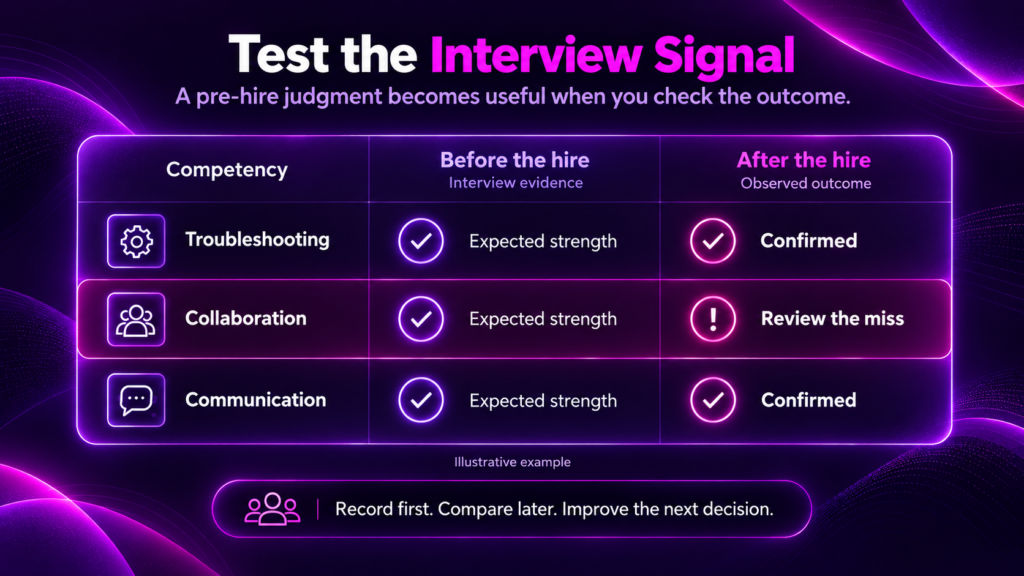
For example: “Troubleshooting: 4/5. Traced a production fault independently; customer communication remains untested.” At the agreed checkpoint, the question is whether the hire can diagnose comparable issues. The 4/5 is an assessment to examine later, not an 80% probability of success.
Weighting competencies for the hiring decision can be useful, but keep post-hire performance and retention visible separately. One blended score can hide what actually happened.
How Do You Test Whether the Interview Signal Held Up?
Start with one role family and include only hires who have reached the same outcome checkpoint. For each competency, compare outcomes for hires who scored high with those who scored lower. Where stronger scores did not align with stronger performance, review the recorded answers, question, and scoring guide, then check changes against a later cohort.
Small cohorts produce unstable patterns. Managers may rate performance differently, while onboarding and changes to the role affect outcomes. Because you observe outcomes only for people hired, this analysis can identify associations within your hires. It cannot establish how rejected candidates would have performed or prove that an interview caused a later result.
Start With the Prediction
The sequence I would give any hiring leader is simple: agree on success, capture the interview’s assessment, wait for a comparable outcome, and inspect where the two diverge.
Relevana is built for the first half of that sequence, the part that has to happen before anyone is hired. The recruiter builds a Blueprint from the role, and the hiring manager approves it before the first interview. A recruiter leads the live conversation while AI supports follow-ups and documentation in the background. The Interview Report records the scored evidence, and Next Round Prep carries what remains untested into the next conversation. Pair that record with your own post-hire outcomes, and the team has a prediction it can check.
For a deeper look at why first-round evidence gets lost before anyone can test it, read our white paper on the signal crisis.
