Reduce Time to Hire With a Hiring Wait Ratio Audit
Most talent leaders are asked to reduce time to hire, and most of us already know the shortcut. Drop an interview. Approve the second candidate instead of the fifth. Skip the assessment. The metric moves this quarter, and the cost may arrive months later as an unplanned backfill.
I would take one measurement before touching any stage. The question worth answering is not how fast the process runs, but how much of it was ever spent assessing anyone.
What is the Hiring Wait Ratio?
It is a diagnostic you can run in an afternoon. Review your last ten hires, classify every calendar day as evaluation time or waiting time, then calculate:
- Hiring Wait Ratio = Waiting days ÷ Total hiring days
Evaluation time is any day spent interviewing, reviewing submitted work, or making a decision. Waiting time is everything else: scheduling, chasing scorecards, arranging debriefs, securing approvals, and re-asking questions an earlier round should have settled.
This is not an industry benchmark. It is a baseline for your own process. If a 30-day cycle contains 22 waiting days, removing a useful interview is solving the wrong problem.
Why the Ratio Beats the Total
A single time-to-hire number tells you the process is slow. It does not tell you whether cutting anything is safe.
The ratio does, because evaluation days are the only ones where a reduction changes what you know about the candidate. Waiting days consume calendar and return nothing.
What Chipotle’s Numbers Actually Show
Chipotle reported reducing application-to-start time from 12 days to four in a February 2025 update, with application completion rising from approximately 50% to more than 85%. These are company-reported results from frontline, high-volume hiring, so they are not a benchmark for professional roles.
The operational lesson may apply beyond frontline hiring: remove routine coordination while people continue to interview and decide. The assistant answered routine questions, collected information, booked interviews, and sent offers once managers had chosen. The manager continued to interview and decide. What compressed was the queue around that judgment.
That distinction matters more as roles get more senior, because skilled candidates quietly opt out of processes that replace the conversation with a machine. Greenhouse’s 2026 research found that 38% of candidates have walked away from a hiring process because it included a bot-led interview. Speed taken out of the queue costs nothing. Speed taken out of the interview does.
How to Read Your Result
The ratio tells you how much room you have. Where the waiting sits tells you what to fix first. Three patterns come up repeatedly.
Waiting concentrated in scheduling. A coordination problem, and the easiest to solve, because booking and rebooking carry no judgment content. Automate routine booking and rebooking where appropriate before cutting an assessment stage.
Waiting concentrated in feedback and debriefs. This is an ownership problem. Assign criteria to named interviewers before the round begins. Capture evidence during the conversation and make the scored report available promptly afterward, rather than after it, so usable evidence exists the moment the interview ends.
Waiting concentrated in later rounds re-covering earlier ground. This is an evidence problem, and the one teams are least likely to record as delay, because it shows up on the calendar as one more round to be sure. A simple test: count how many questions in round two were already asked in round one. Every repeat is a sign the first interview’s evidence never reached the next interviewer. Here the constraint is the quality of the handoff, not the diary.
Structure Is the Guardrail
Removing queues stays safe only while the evaluation itself remains structured. Research reviewed by the Society for Industrial and Organizational Psychology, drawing on Sackett and colleagues’ re-analysis of decades of selection data, placed structured interviews among the strongest predictors of job performance. Faster coordination is compatible with that finding. Improvised interviewing is not.
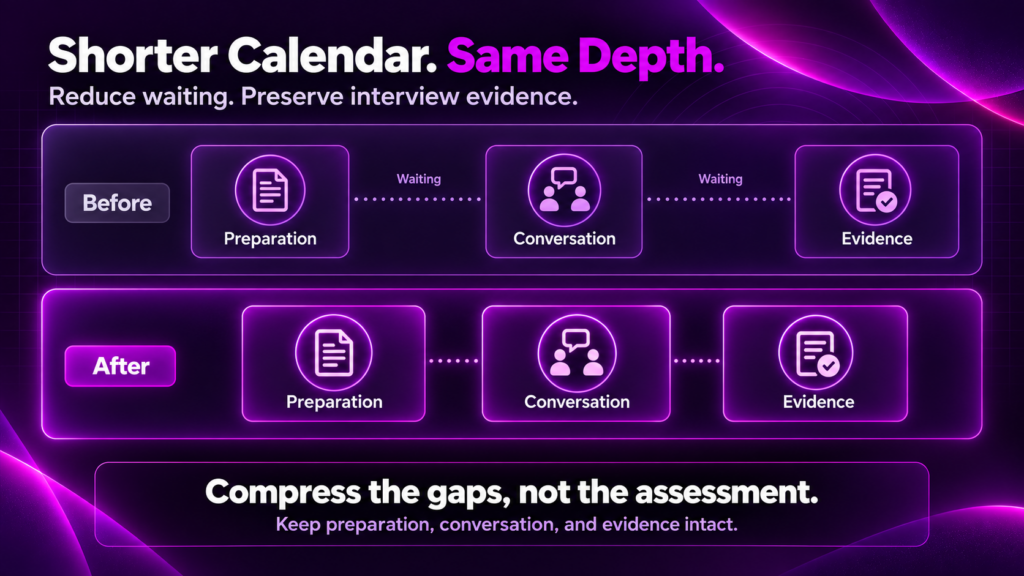
In practice, I take that to mean agreeing with the interview standard before anyone is interviewed, keeping the conversation recruiter-led, and letting technology work quietly behind it. That is how we built Relevana: a Blueprint the hiring manager approves before round one, real-time insights while the recruiter leads the interview, an Interview Report the same day, and Next Round Prep so the next conversation opens where the last one closed.
Remove Waiting, Not Judgment
Run the ratio, attack the largest queue, and consider removing a stage only once the evidence shows it added little. Reducing time to hire should mean fewer days waiting to use what your team already knows, not fewer days spent learning it.
If most of your waiting sits in that third pattern, the fix starts in round one. Our white paper, Human-Led Interview Intelligence: Solving the Signal Crisis examines why first-interview evidence decides how fast every round after it can move.
