Why Skilled Professionals Are Opting Out of Automated Video Interviews
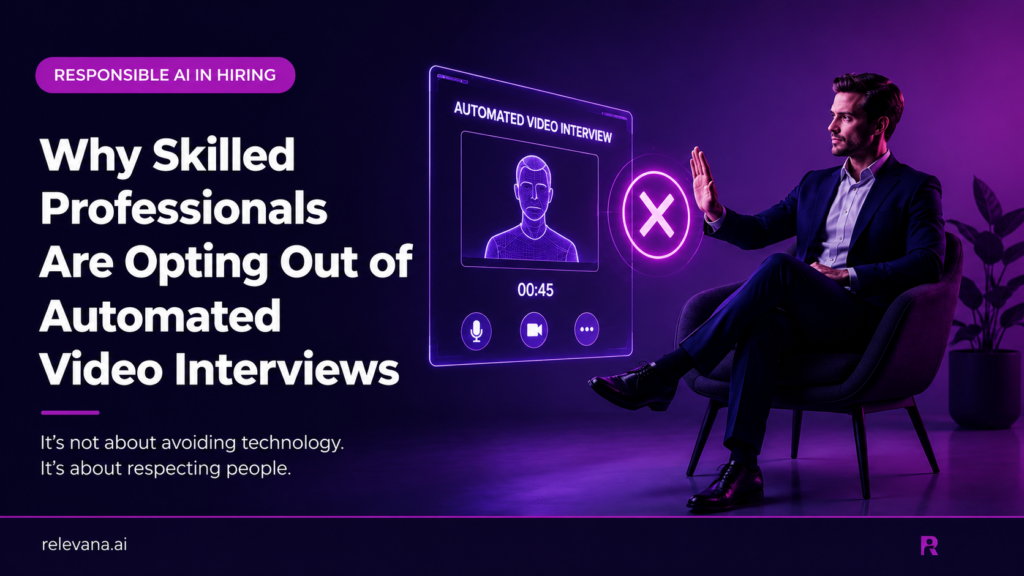
There is a lot of excitement right now around automating interviews. I get it. On the surface, it sounds efficient. Record a few responses, run the answers through a system, move people through faster, save time. For certain high-volume roles, maybe that model has a place. But when you move into skilled, experienced, professional hiring, I think a lot of companies are missing something important. The process starts feeling efficient to the company and strangely empty to the candidate.
That is the disconnect.
Why Candidate Experience Matters in Skilled Hiring
When you are talking about senior engineers, architects, strategic operators, experienced recruiters, or domain experts, the interview is not just a box to check. It is a real evaluation on both sides. The candidate is assessing the company just as much as the company is assessing the candidate. So when the process starts with a one-way automated video interview, it can send a message the company never intended to send. It can feel like, “Talk to the machine first, and maybe a human will care later.” That is not a great first impression for top talent.
Why Automated Interviews Miss Real Expertise
A big part of the problem is that strong professionals do not think in neat little keyword-friendly packages. Their real value often shows up in nuance, trade-offs, judgment calls, and experience-based reasoning. Sometimes the smartest answer in an interview is, “It depends.” Not because the person is dodging the question, but because real work is full of constraints, competing priorities, and imperfect information. That kind of thinking is exactly what senior talent brings to the table. The problem is that rigid, one-way interview systems are not very good at picking up that kind of signal. They are much better at rewarding polished delivery and prompt-shaped answers.
And that creates another issue. These systems can start rewarding performance more than practice. Talking alone to a camera is not the same thing as collaborating, solving, listening, responding, or thinking in real time. Some people are naturally comfortable delivering a crisp answer into a webcam. Others are much stronger in a real conversation where they can ask clarifying questions, explore the problem, and think out loud. If the format favors camera comfort, scripting, and presentation polish, then you are not always measuring who is best for the role. Sometimes you are measuring who is best at acting like they are already inside the format. That is a very different thing.
There is also the trust issue. As noted by Harvard Business Review, automated interviews can struggle to evaluate nuanced thinking and decision-making, which raises concerns for experienced candidates. A lot of automated video interview systems do not clearly explain how responses are evaluated, how bias is addressed, or what happens to the data. Candidates are asked to hand over a piece of themselves without really knowing how the process works. That is a hard ask, especially when the stakes are high. Add in the fact that many of these systems are easy to game with rehearsed answers, scripts, or AI-assisted prep, and the whole thing starts to feel shaky. Strong candidates notice that. A lot of them do not complain. They just quietly disengage.
Human vs Automated Interviews: What Works Better
That is why I do not think the future of hiring is about removing humans from interviews. I think it is about making human interviews better. Better prepared. Better structured. Better grounded in the actual job. Better at pulling out real evidence instead of surface-level performance. That is where AI can be incredibly useful. Not as a replacement for human judgment, but as a support system that helps recruiters and hiring teams ask better questions, go deeper, and evaluate more consistently.
For skilled hiring, interview quality is a competitive advantage. The best candidates want a real conversation. They want context. They want someone who can actually listen, probe, and understand how they think. If the process feels too robotic, too scripted, or too distant, companies risk losing exactly the people they are hoping to attract. That is why I believe AI belongs behind the scenes, strengthening the interview, not replacing it. For senior roles, better outcomes come from better human conversations, with AI helping create structure, clarity, and stronger signal along the way.
