Skills-Based Hiring Only Works If You Can Measure Skills
Removing a degree requirement takes one edit to a job posting. Evaluating candidates who enter through that newly open door takes a different kind of work. I have seen skills-based hiring stall at the point where a recruiter asks a hiring manager, “What would actually prove this person can do the job?”
The answer needs to be agreed before the interview, then recorded well enough that another interviewer can use it.
Has Skills-Based Hiring Changed Who Gets Hired?
Harvard Business School and the Burning Glass Institute studied about 11,300 roles at large U.S. firms. Where employers removed degree requirements, the share of hires without a degree increased by an average of 3.5 percentage points. Across all hires, fewer than one in 700 benefited from those reforms. Most of the observed hiring change occurred at 37% of the firms studied.
A 2026 Burning Glass Institute and OneTen study found a related result. Employers that removed degree requirements saw only a two-percentage-point increase in the share of hires with nondegree credentials. A credential is one potential signal of skill. It still needs to be mapped to the work the role requires.
Walmart says 90% of its U.S. roles do not require a degree. It also participates in an initiative to develop shared definitions of skills for common roles. Its example shows the scale of the opportunity; the measurement problem remains local to each role and hiring team.
LinkedIn’s 2025 Future of Recruiting report found that more than nine in ten surveyed talent acquisition professionals regarded accurate skills assessment as crucial to quality of hire.
These sources measure outcomes and stated views, so the cause of the gap is open to interpretation. My interpretation comes from the interview room.
What Does a Skills Assessment Need to Show?
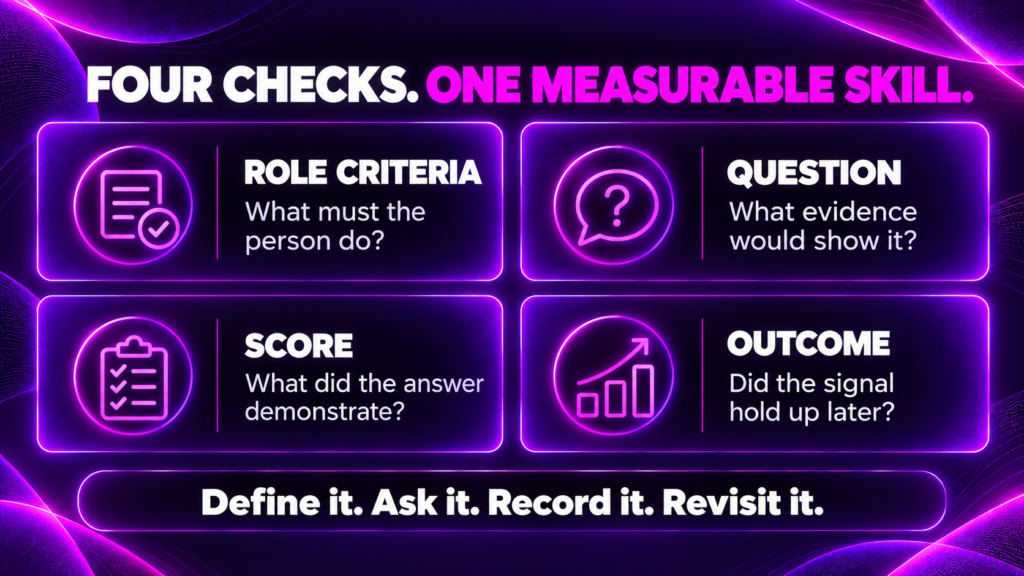
I would begin with a role-specific question: “What could this candidate say or demonstrate that would change our confidence?” Consider an operations role requiring incident response. “Good problem solver” gives an interviewer little to test. “Can identify an incident’s likely cause, explain the trade-offs in the response, and communicate the next action” is observable.
The scoring guide then describes what each level sounds like. A weak answer names a cause without explaining how the candidate reached it. A solid answer walks through the evidence they checked and the trade-off they accepted. A strong answer covers all of that and adds what they would change to prevent a repeat. Interviewers who agree on those descriptions in advance can compare candidates on the same terms.
Before the interview
- Define the role’s critical competencies and what strong answers look like.
- Agree on a scoring guide so every interviewer rates the same way.
During the interview
- Ask comparable, role-relevant questions and probe for specifics.
- Note what the candidate demonstrated and what remains unclear.
After the interview
- Record the answer and evidence behind each score.
- Give the next interviewer a focused question to follow up on.
This makes the evaluation inspectable. If a hire later struggles with incident response, the team can revisit the pre-hire answer and ask whether its question or scoring guide missed something. A score alone cannot tell them that.
How Relevana Carries the Evidence Forward
Relevana starts where skills-based hiring usually stalls. The recruiter builds a Blueprint from the role, and the hiring manager approves it before the first conversation. From that Blueprint, Relevana generates role-specific questions and follow-ups, so a skill like incident response becomes something an interviewer can test, whether the role is in engineering, finance or nursing. The recruiter leads a live interview while AI surfaces follow-ups and captures answers against the agreed topics. The Interview Report brings the questions, scores and evidence together. Next Round Prep shows the next interviewer what has been established, what still needs probing, and the Conviction Question: the one question that, answered well, gives the team conviction on the hire. The hiring team owns the decision.
That sequence turns a claim about skills into a record the team can revisit. Our guides to building a hiring Blueprint and handing off interview evidence explain the two ends of the process.
Start With One Role
Opening a role to more applicants is worthwhile. To learn whether it changes hiring, I would start by defining the skills, asking for evidence in a human-led conversation, and checking the resulting decisions against later performance. See how Relevana turns a skills definition into interview evidence.
