The Hiring Decision Nobody Owns

“Most hiring does not stall because the candidates are weak. It stalls because the debrief ends in a feeling, and a feeling has no owner.”
Here is a meeting you have been in. Four people interviewed the same candidate. Everyone gathers. The recruiter asks how it went.
The first person says they liked them. The second says they were fine but is not sure about the level. The third missed the call and read the notes. The fourth has a concern they cannot quite articulate, so it comes out as culture. Forty minutes later the group agrees to keep looking, or to bring the candidate back for one more conversation that nobody has defined the purpose of.
Nothing in that meeting was a decision. It was a mood, taken collectively.
Consensus Is Not a Decision Rule
A hiring decision is a judgment made by one named person against a standard agreed before anyone was interviewed. Most teams have written down neither. They have a process for scheduling and a process for offers, and in between there is a debrief where the answer emerges from the conversation.
The trouble with emergent answers is that they follow whoever speaks first, whoever is most senior, and whoever is most confident. None of those three correlate with being right about a candidate.
Emergent answers follow whoever speaks first, whoever is most senior, and whoever is most confident.
Three Things That Fix It
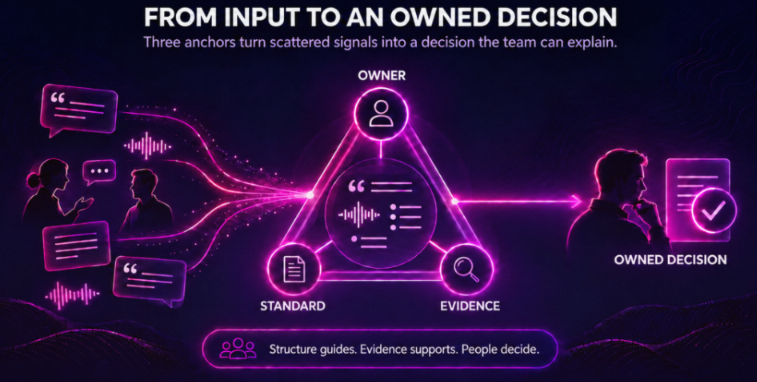
All three start before the first interview. That is what we built the Blueprint to establish: the role’s weighted priorities and repeatable questions, agreed before anyone is interviewed. The team names the decision owner and rule upfront. During the live interview, the recruiter leads while AI works in the background, surfacing follow-ups and capturing evidence against the agreed criteria. Nothing has to be reconstructed once the debrief starts.
- Name the decision owner before the role opens. One person makes the call. Everyone else supplies evidence. A panel is an input, not a committee, and telling people that up front changes how they prepare.
- Agree the decision rule in advance. What would make this a yes. What would make it a no regardless of everything else. Write it down where the panel can see it. A rule written before you meet anyone is a standard. A rule written afterwards is a justification.
- Ask for evidence, not impressions. In the debrief, replace how did it go with what did they say. The first invites a summary of a feeling. The second invites a quote, and quotes can be compared.
What Changes
The debrief gets shorter, which people notice immediately, but that is not the real gain. The real gain is that you can explain the decision later. This serves the candidate looking for growth, the manager welcoming a new team member, and the regulator demanding formal accountability. And where automated hiring tools are involved, the record employers may need to produce, is becoming more formal.
There is a second gain, one round later. When the Interview Report carries what was said and Next Round Prep flags what is still open, the next conversation starts where the last one ended. Evidence compounds. Impressions do not.
A hiring process that cannot explain its own decisions is not neutral. It is simply unexamined, and unexamined processes are where bias lives most comfortably.
The Cost Of Not Deciding
Every extra loop has a price that nobody puts on a slide. The candidate who takes the other offer while you schedule a fifth conversation. The team that carries the gap for another six weeks. The hiring manager who eventually takes whoever is still available in month four, which is the worst version of a hiring decision and almost always the result of a process that could not close, not of a shortage of candidates.
Indecision feels safer than a wrong hire, which is why it is so common. It is not safer. It is a decision to keep the role open, made without anyone having to own it.
What This Is Not
This is not a case for removing judgment from hiring. Judgment is the whole point of interviewing a person rather than scoring a resume. The argument is about when judgment gets applied and against what.
Judgment applied to evidence, against a standard set in advance, is expertise. That is not only a preference. In a major 2022 re-analysis of personnel-selection research, structured interviews came out as the strongest single predictor of job performance. The same judgment applied to a general impression, after the fact, against a standard that forms as you speak, is preference wearing expertise as a coat. The interviewers are the same people in both cases. Only the structure around them changed.
The Test
Take your last rejection at final stage. Ask the panel, separately, why that candidate did not get the job. If you get four different answers, you did not have a decision. You had four opinions and a calendar invite.
We wrote about where that evidence goes missing in Solving the Signal Crisis.
