The Future of Hiring: Why AI Needs Human Judgment in 2026
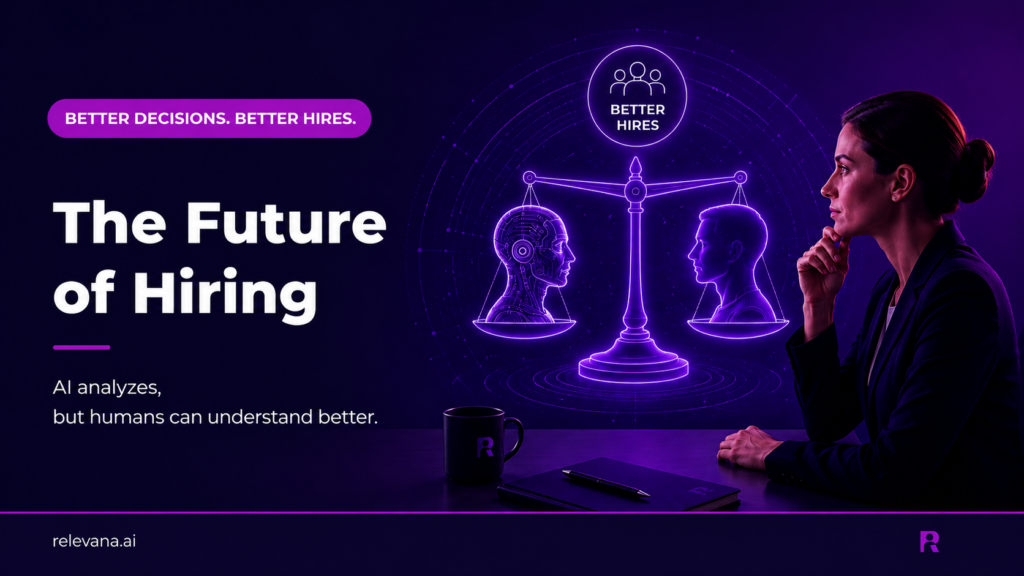
There’s a pattern I’ve been noticing in how teams talk about AI in hiring right now. The goals are always familiar: reduce bias, improve consistency, and make faster, more reliable decisions. And to be fair, I’ve seen AI start to deliver on some of that.
But somewhere along the way, the conversation drifts into a more extreme question: “How much of hiring can we automate away?” That’s where things start to feel off to me. Because most hiring leaders I talk to aren’t trying to remove judgment, they’re trying to scale it without losing quality.
Pros of AI in Hiring: Speed, Scale, and Standardization
AI in hiring didn’t take off without reason. There are real advantages when it’s used correctly: the ability to screen large volumes of candidates in a short period of time, create a level playing field in early-stage evaluation, and significantly improve hiring velocity. According to Society for Human Resource Management’s 2025 Talent Trends report, AI adoption in HR has climbed to around 43%, largely driven by the need to reduce time-to-hire. In high-volume or operational roles, that efficiency is a genuine gamechanger.
But I’ve learned something the hard way; efficiency isn’t accuracy, and it’s definitely not judgment.
AI Bias in Hiring: Risks of Automated Decision-Making Systems
AI systems are world-class at identifying patterns, but they rely heavily on historical data, which creates a risk many teams underestimate: automated replication. A 2025 report from the Equal Employment Opportunity Commission warns that AI hiring tools can unintentionally embed historical bias if left unchecked. Not because the system has bad intent, but because it learns from the world as it is, not as it should be. If your past hiring decisions weren’t neutral, your AI won’t be either.
Human Bias in Hiring: Why Unstructured Interviews Fail
Bias, of course, didn’t start with AI. It existed long before. In my experience, it shows up in quiet, unstructured ways, two interviewers asking completely different questions, or decisions forming in the first 30 seconds based on “culture fit,” which, if we’re honest, is often just code for familiarity. Whether it’s human or machine, unstructured decision-making is where bias thrives.
The Qualitative Blind Spot: What AI Can’t “See”
Beyond data bias, there is a fundamental limitation to AI that we often overlook: it cannot evaluate how a candidate actually thinks and behaves under real conditions. A machine can parse a resume for keywords or analyze a transcript for logic, but it fails to grasp the nuances that actually define a great hire:
- Behavior and Maturity: How a candidate carries themselves and their level of professional self-awareness.
- Pressure and Resilience: The ability to stay composed during a difficult technical deep-dive or pivot when a business case changes mid-stream.
- Nuance: The “soft signals,” the pause before a difficult answer, the humility in a success story, or the spark of genuine curiosity.
These aren’t just “feelings”; they are critical indicators of performance. When we automate these away, we aren’t just removing bias; we’re removing the very signals that determine whether someone will succeed once they’re hired. AI can process answers. It can’t judge how those answers are delivered.
Future of AI in Recruitment: Human-in-the-Loop Hiring Models
If you look at where hiring is heading in 2026, it’s not toward full automation but toward augmented decision-making. Even Gartner highlights a shift toward “human-in-the-loop” hiring models. The reason is simple: fully automated systems introduce a trust gap. Their research shows that only about 26% of candidates trust AI to evaluate them fairly. When context and the human element disappear, trust usually follows.
Structured Interviews: Reducing Bias Without Removing Judgment
So where does that leave us? For me, the answer isn’t removing judgment; it’s shaping it. This is where structured interviews become powerful. When interviews are designed with clear evaluation criteria, consistent coverage, and defined scoring, something subtle shifts. My decisions become less about who I happened to be in the room with and more about what the candidate actually demonstrated, both in skill and in character.
Evidence-Based Hiring: The Role of Transparency and Visibility
The biggest driver of bias, in my view, is invisible reasoning. If my feedback is just “didn’t feel like a fit,” there’s nothing to challenge or calibrate. But when interviews produce a clear record of what I asked, how the candidate responded, and why I gave that score, I’m no longer reacting to an opinion, I’m evaluating evidence.
This is also why I find fully automated interviews limiting. They remove variation, but they also remove accountability, real-time judgment, and the ability to explore unexpected depth.
AI + Human Judgment: The Right Hiring Model for 2026
The future of hiring isn’t Human vs. AI. It’s a better question: how do we combine both without amplifying their weaknesses? In my work, I lean toward a model where:
- The recruiter leads the conversation to capture behavior, maturity, and nuances.
- AI ensures consistency and coverage of core requirements.
- Evaluation remains structured and evidence-based.
AI isn’t making the decision, it’s helping me stay grounded, complete, and comparable.
Wrapping It Up
Bias in hiring isn’t solved by removing people, and it’s definitely not solved by blindly trusting a black box. It’s reduced when judgment is deliberate, interviews are structured, and decisions are visible. Because in that kind of system, judgment doesn’t go away, it becomes structured, visible, and far more reliable. And that’s what makes it worth trusting.
